Rug Symbols Guide|Arsh's Rugs
Rug Symbols Guide
What the common motifs in tribal and Afghan-style rugs are said to mean, and how to describe them honestly.
Commonly cited, but less standard
Gul (elephant foot)
A repeating octagonal or polygonal medallion, usually in rows across the field.
Each tribal group had its own version, so the gul works as a clan or tribal emblem. Protection and status are commonly given as secondary readings.
Diamond and stepped diamond
A lozenge, sometimes stepped or with hooked edges.
Most often described as a protective symbol, sometimes called the eye, meant to ward off the evil eye and keep the household safe.
Repeated small motifs and borders
Rows or bands of the same small shape, framing the field.
Repetition is often read as a kind of woven protection. Borders are described as framing bands that guard the field. This is an interpretation rather than a documented rule.
Paired diamonds (hourglass)
Two diamonds meeting at a point.
Described as union, community and shared protection.
Search our site:Kilim RugsTribal
Tree of life
A central trunk with branches, sometimes with leaves, fruit or birds.
Associated with growth, fertility, and continuity of life, and with a link between earth and the divine.
Mihrab (prayer arch)
A pointed or rounded arch at one end of a rug.
Marks the direction of prayer. Often contains lamps, cypress trees or flowers.
Boteh (paisley)
A teardrop or comma shape with a curved tip.
Linked to flame, seed, leaf or cypress imagery, and to eternity, growth and fertility.
Ram's horn
A curling S-shaped or volute form.
Associated with strength, masculinity and protection, reflecting a herding life. Often placed in borders as a guardian.
Search our site:Kilim RugsTribal
Hooks and S-shapes
Right-angle hooks and flowing S-curves, mostly in borders.
The S is sometimes read as a solar symbol, and hooks are thought to deflect negative energy.
Zigzag
An angular line, horizontal or diagonal.
Read as mountains when used as a border and as flowing water when diagonal.
Star
A star or rosette form.
Associated with joy, light and happiness.
Elibelinde (hands-on-hips)
A stylized figure with hands on hips.
A fertility symbol tied to womanhood and the continuity of family.
Search our site:Kilim Rugs
Birds
Abstracted bird shapes.
Different sources describe them as freedom, the human soul, or happiness. There is no single agreed meaning.
Dogs, camels and other animals
Simplified animal figures, often tiny and in rows.
Dogs are read as guardianship in one source, and camels and scorpions as mobility and strength in another. Treat any one meaning as one view among several.
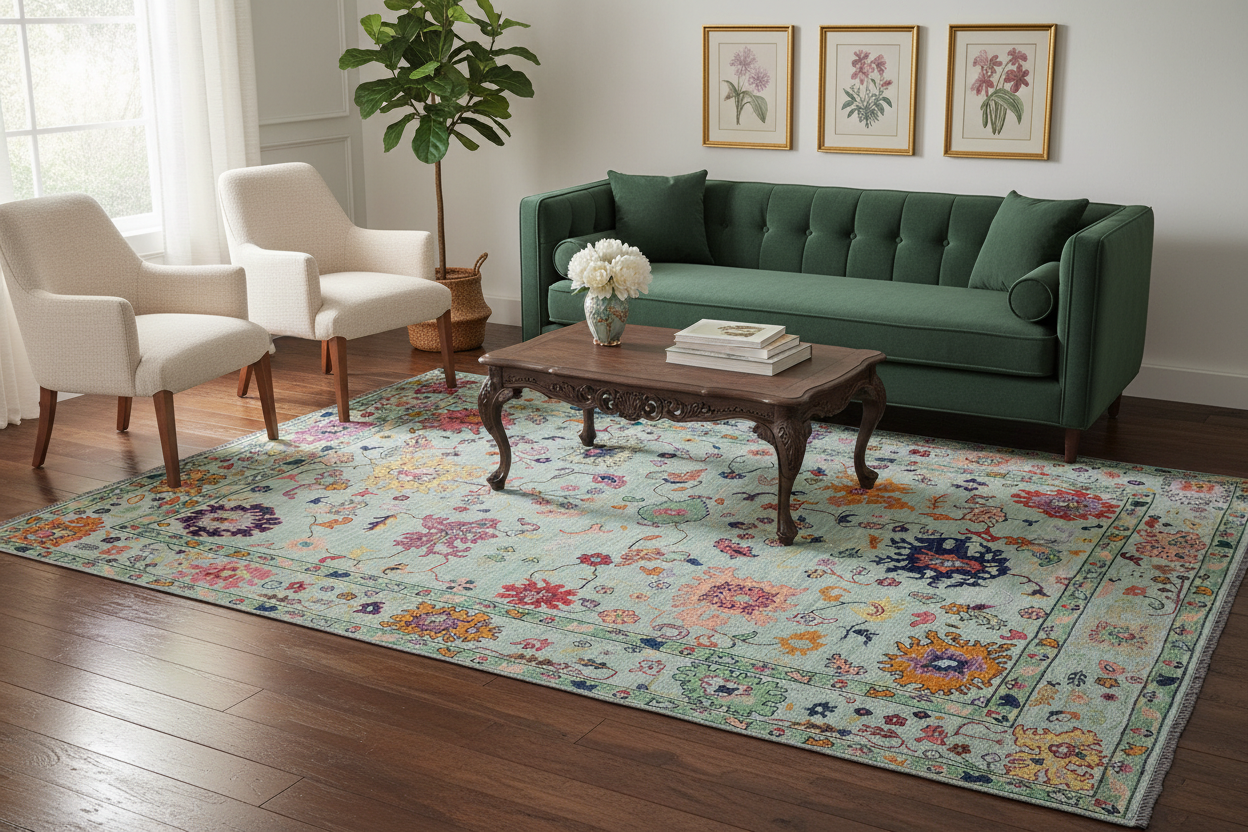
Floral motifs
Flowers, blossoms and vines.
Associated with fertility and abundance in general terms.
Geometric patterns in general
Angular, repeating shapes.
Described as reflecting the nomadic way of life, or as a weaver's personal artistic signature. Baluch geometric designs are often linked to protection and cultural heritage.
Design layouts in our newer collections
Diamond lattice (Moroccan trellis)
An open grid of diamonds, often drawn loosely and in a single color on a pale or dark ground.
In Berber weaving, lozenges and lattices are often read as protection and as a nod to fertility and family life. These are popular readings, and weavers differ on specifics, so describe the pattern first and the meaning only as "often read as".
Search our site:Moroccan
Biljik layout (Khal Mohammadi)
Rows of stylized floral and geometric motifs repeated across a deep red field, framed by narrow borders.
Biljik is the name of the design rather than a symbol with a documented meaning. It is described as drawing on nature, with stylized flowers and geometric forms laid out in a regular grid.
Search our site:Khal MohammadiBiljik
Bokhara gul grid
Rows and columns of the same octagonal gul, with small diamonds between them.
The gul is a tribal emblem, and the strict grid is what defines the Bokhara layout. Describe the symmetry and repetition, and keep any meaning to "the gul is a tribal emblem."
Search our site:Bokhara
Central medallion
A large shape in the center of the field, often with matching corner pieces.
Persian medallions are described in various ways, including a dome, a flower, or a sun, and none of these is documented as the weaver's intent. Use it as a visual description.
Search our site:PersianPak Persian
Herati / Mahi (fish) pattern
A repeating lozenge with a flower inside, flanked by curved leaves, covering the field.
Herati is the traditional name, and in Persian rugs it is often called Mahi, meaning "fish", after the leaf shapes. The name is documented, but no particular symbolic meaning is, so use the name and describe the look.
Search our site:Persian
Lattice of small crosses and diamonds (Balochi)
Plus-shaped and diamond motifs set in an all-over grid of bright colors.
Baluch geometric patterns are often linked to protection and cultural heritage, but this is a general reading and not tied to a specific motif.
Search our site:Balochi
More design layouts from across the catalog
 Example: A3271, Abusson Pak-Persian Afton Rust/Taupe Wool Rug
Medallion with corner pieces
A large shape at the center of the field, repeated in quarter form in the four corners.
A classic Persian layout, often described as a dome seen from below, a flower, or a sun. None of these is documented as the weaver's intent, so describe the layout first and the reading second.
PersianKerman stylePak Persian
Search our site:Pak PersianPersian
 Example: A5244, Istanbul Jerrell Tan/Gray Wool Rug
Garden compartments (Bakhtiari / paradise garden)
The field divided into a grid of small panels, each filled with a tree, flower or plant.
Commonly described as a stylized garden, drawing on the Persian idea of a walled paradise garden. This reading is widely repeated in books and by retailers.
PersianBakhtiari style
Search our site:PersianPak Persian
 Example: A12920, Antique Ethnic Turkish Tiny Handwoven Kilim Runner
Stripes and bands
Horizontal or vertical bands of color, sometimes with narrow patterned stripes between them.
A basic structure of nomadic flat weaves, where each band is woven across the width in one pass. It is mostly decorative, so describe it visually and avoid giving it a meaning.
KilimsNomadic weaving
Search our site:Kilim RugsKhurgeen
 Example: A5750, Bohemian Kazak Tribal Paityn Red/Beige Wool Rug
Kazak medallion layout
A bold central medallion, often flanked by smaller ones, on a field with a wide border.
Kazak rugs are known for bold, large-scale layouts, and the types are traditionally named for Caucasian districts and villages. Describe the layout and avoid assigning meanings to the medallion shapes.
CaucasianKazak
Search our site:KazakSuper Kazak
 Example: A5163, Soumak Sal Rust/Ivory Wool Rug
Large octagon guls in a quartered layout
A few big octagonal medallions, each divided into quarters, on a deep red ground.
A form of the gul, the emblem tribal groups used to identify a clan. The large, quartered octagon is a recognizable Turkmen layout, though attribution to a single tribe is not always certain.
TurkmenSoumak
Rug styles: Traditional, Tribal, Modern, Transitional


Traditional
Classic Persian and Oriental layouts: a central medallion or an all-over floral field, framed by several border bands.
Rich reds, blues, creams and earth tones, with curving vines, palmettes and medallions. In our catalog this covers the Traditional, Pak Persian, Ziegler and Persian collections. When describing, name the layout first (medallion or all-over), then the border and palette.


Tribal
Geometric designs rooted in nomadic and village weaving: gul grids, diamonds and bold medallions in saturated colors.
Lines are more hand-drawn and less symmetrical than in city-workshop rugs. In our titles, "tribal" describes the style, not a documented tribe, so avoid attributing a rug to a specific group unless the source says so. Covers Kazak, Balochi, Khal Mohammadi, Bokhara, Khurgeen and many Kilims.


Modern
Abstract, minimalist or contemporary designs: stripes, nets, color fields, shag and bold graphic geometry.
Often a limited palette and a lot of open space, and mostly flat weave or shag. These designs do not carry traditional symbolism, so describe the look and the room it suits. Covers Modern Kilim, Moroccan, Balochi Modern and Dhuri.


Transitional
Traditional motifs, simplified or softened: vines, florals and medallions with more open space and quieter colors.
A bridge between classic and contemporary decor. In our catalog, most Transitional rugs are Pak Persian pieces with William Morris-style vines and flowers, in muted or unexpected colors. Describe them as classic designs in a fresher palette.
Search our site:TransitionalPak Persian
How to use this in product descriptions
| Pattern in the rug | Safe wording |
|---|---|
| Central medallion | "echoes the gul, the emblem tribal weavers used to identify a family or clan" |
| Diamonds and stepped diamonds | "often read as symbols of protection for the home" |
| Bands or rows of repeated motifs | "repetition is often read as a kind of woven protection" |
| Nested borders | "borders like these are often read as protective frames" |
| Diamond lattice (Moroccan style) | "a diamond lattice in the Berber tradition, often read as a symbol of protection" |
| Biljik rows (Khal Mohammadi) | "the Biljik design, with stylized floral and geometric motifs inspired by nature" |
| Bokhara gul grid | "rows of the gul, a tribal emblem, in a strict geometric layout" |
| Herati or Mahi pattern | "the Herati (Mahi, or fish) pattern, a traditional all-over Persian design" |
| Animals and birds | Describe them visually only. Avoid stating a meaning. |
| Anything else | Say "associated with" or "believed to". Never state a symbol "means" something. |
Weave and knot types
| Term | What it is | Where you find it |
|---|---|---|
| Persian (Senneh) single knot | Each knot is tied around one warp thread, which allows finer detail and sharper curves, so it is common on floral and curvilinear designs. | Pak Persian, Bokhara, Vegetable Dyed |
| Turkish (Ghiordes) double knot | Each knot wraps two warp threads. It makes a dense, sturdy pile and is common on geometric and tribal designs. | Kazak, Super Kazak, Khal Mohammadi, Khurgeen, Istanbul, Ziegler |
| Flat weave (kilim) | Woven with no knots and no pile, so the pattern shows the same on both sides. It is lightweight and easy to move. | Kilim, Modern Kilim, Dhuri |
| Soumak | A flat weave in which the weft threads wrap around the warps, which gives a raised, braided texture, something like a herringbone. | Soumak |
| Shag and high-low pile | A deep, soft pile, or a pile cut at two heights so that the design stands up in relief. | Moroccan |
Glossary
| Term | Meaning |
|---|---|
| Field | The main area of the rug inside the borders. |
| Border | The band, or set of bands, that frames the field. |
| Medallion | A large shape at the center of the field. |
| Spandrel | The corner pieces of a field that repeat part of the medallion. |
| Gul | A repeating medallion that tribal weavers used as a clan or family emblem. |
| Abrash | A gradual change of shade within one color area, caused by differences between batches of hand-spun wool or dye. It is a normal sign of a handmade rug. |
| Pile | The cut ends of the knots that make up the surface of a knotted rug. |
| Warp and weft | The threads that run the length of the rug (warp) and across it (weft), forming the foundation of the weave. |
| Hand knotted | Every knot is tied by hand on a loom. |
| Hand woven | Made by weaving on a loom without knots, as in kilims and soumaks. |
| Handmade | A general term for any rug made by hand rather than by machine. |
| Runner | A long, narrow rug, used in hallways, entries and kitchens. |
Frequently asked questions
Are Moroccan-style rugs made in Morocco?
No. Our Moroccan-style rugs are hand knotted in Pakistan, and a few in Afghanistan, in a design inspired by Berber weaving. The Origin line in each product's details tells you where it was made.
What is the difference between Persian and Pak Persian?
Persian rugs are made in Iran. Pak Persian rugs are hand knotted in Pakistan in classic Persian designs, using the Persian single knot.
What does vegetable dyed mean?
The wool is colored with dyes made from plants, roots and other natural sources, instead of synthetic dyes. The colors tend to be softer and can vary slightly across the rug.
What is the difference between hand knotted and hand woven?
A hand knotted rug has a pile made of individually tied knots. A hand woven rug, such as a kilim, is flat-woven without knots and has no pile.
Will the rug look exactly like the photo?
Very close, but not identical. Each rug is handmade, and screens vary, so small differences in shade and detail are normal.
What about shipping and returns?
Every rug ships free to the contiguous U.S. and can be returned within 14 days. See the Shipping and Returns page for details.
Border patterns
Guard stripes
Thin parallel bands running along each side of the main border.
These frame the main border and give the rug a clean edge. They are a structural feature and carry no documented meaning.
Running dog (meander)
A repeating wave or S-shaped line that runs continuously around the border.
Often read as water or as continuity, because the line never breaks. This is a popular reading.
Reciprocal (sawtooth) border
Interlocking triangles or notches that form a zigzag edge.
Common on Caucasian and Kazak rugs. It is a decorative pattern, and it is best described by its look.
Rosette and vine border
Flowers or rosettes connected by a winding vine.
Associated with growth and abundance in general terms, and common on Persian and Pak Persian rugs.
Dyes and abrash
| Dye type | What it means | Collections |
|---|---|---|
| Vegetable dyed | Plant-based dyes, with a softer, slightly varied color. | Istanbul, Vegetable Dyed, Kazak, Super Kazak, Khurgeen, Khal Mohammadi, Balochi, Ziegler, Soumak |
| Natural dyes | Dyes from natural sources, used on hand-spun wool. | Kilim, Modern Kilim, Dhuri |
| Chrome dyed | A synthetic dye process known for strong, lasting color. | Pak Persian |
Abrash, a gradual shift in shade, is most visible on vegetable and natural dyed rugs, and it is a sign of hand-spun wool and hand dyeing.
Find your style: collection finder
| If you like | Look at |
|---|---|
| Classic florals and medallions | Pak Persian, Persian, Traditional |
| Bold geometric and tribal | Kazak, Super Kazak, Khal Mohammadi, Bokhara |
| Bright, small-scale geometric | Balochi, Khurgeen |
| Soft, textured and modern | Moroccan, Modern |
| Flat weave and lightweight | Kilim, Soumak |
Size and room guide
| Size | Approx. dimensions | Works well for | Placement tip |
|---|---|---|---|
| 2x3 | 24 x 36 in / 61 x 91 cm | Inside a door, in front of a sink or vanity, a hearth, or as a wall hanging. | Use it as an accent rather than a floor covering, or layer it over a larger rug. |
| 3x5 | 3 x 5 ft / 91 x 152 cm | Entryways, kitchens, bedsides, a mudroom, or in front of an armchair. | Pair two side by side at a long bed. |
| 4x6 | 4 x 6 ft / 122 x 183 cm | A home office chair, a reading corner, a small entry, or a nursery. | Place under a desk chair so it can roll without catching. |
| 5x7 and 5x8 | 5 x 7 to 5 x 8 ft / 152 x 213 to 152 x 244 cm | A bedroom beside the bed, a small living room, a breakfast nook, or a sunroom. | For a twin or full bed, run it along the side or foot of the bed. |
| 6x9 | 6 x 9 ft / 183 x 274 cm | A living room with a small seating group, a dining table for four, or a full bedroom. | Put at least the front legs of the sofa and chairs on the rug. |
| 7x10 | 7 x 10 ft / 213 x 305 cm | A mid-size living room, a dining room, or a queen bedroom. | Leave 12 to 18 inches of bare floor around the edges. |
| 8x10 | 8 x 10 ft / 244 x 305 cm | A living room seating group, a dining table for six, or a queen or king bedroom. | For a bed, it should extend about 18 to 24 inches past each side. |
| 9x12 | 9 x 12 ft / 274 x 366 cm | A large living room, a dining table for eight, an open-plan space, or a king bedroom. | Let all furniture legs sit on the rug to anchor the space. |
| 10x14 | 10 x 14 ft / 305 x 427 cm | Great rooms, large dining rooms, or open lofts. | Use it to define one zone in an open layout. |
| 12x15 and larger | 12 x 15 ft / 366 x 457 cm and up | Oversized living rooms, ballrooms, and statement entries. | Measure the room first, and leave a generous floor margin. |
| Round (4 to 8 ft) | 4 ft / 122 cm, 6 ft / 183 cm, 8 ft / 244 cm | Entry tables, a round dining table, a reading nook. | Choose a rug about 4 ft wider than a round table, so chairs stay on it. |
| Square (6x6 to 10x10) | 6 x 6 ft / 183 cm up to 10 x 10 ft / 305 cm | Square rooms, a square dining table, or under a coffee table. | Use it to echo the shape of a square table or seating group. |
| Runners (2x6 to 3x12) | 2 x 6 ft / 61 x 183 cm up to 3 x 12 ft / 91 x 366 cm | Hallways, entries, kitchens, galleys, and along a bed. | Leave 4 to 6 inches of floor on each side of a hallway, and add a rug pad. |
Quick rules. In a living room, put at least the front legs of the furniture on the rug. Under a dining table, add about 24 inches beyond the table on each side so the chairs stay on the rug when pulled out. In a bedroom, a queen bed usually works with 8x10 or 9x12, and a king with 9x12 or 10x14.
Color associations
| Color | Often associated with |
|---|---|
| Red | Joy, vitality and courage. The most common ground color in tribal rugs. |
| Blue | Protection, calm and water. |
| Green | Nature, growth and paradise gardens. |
| Yellow and gold | The sun, warmth and prosperity. |
| Ivory and white | Purity and light. |
| Black and dark brown | Used mostly for outlines and contrast, and read in different ways by region. |
- Choosing a selection results in a full page refresh.