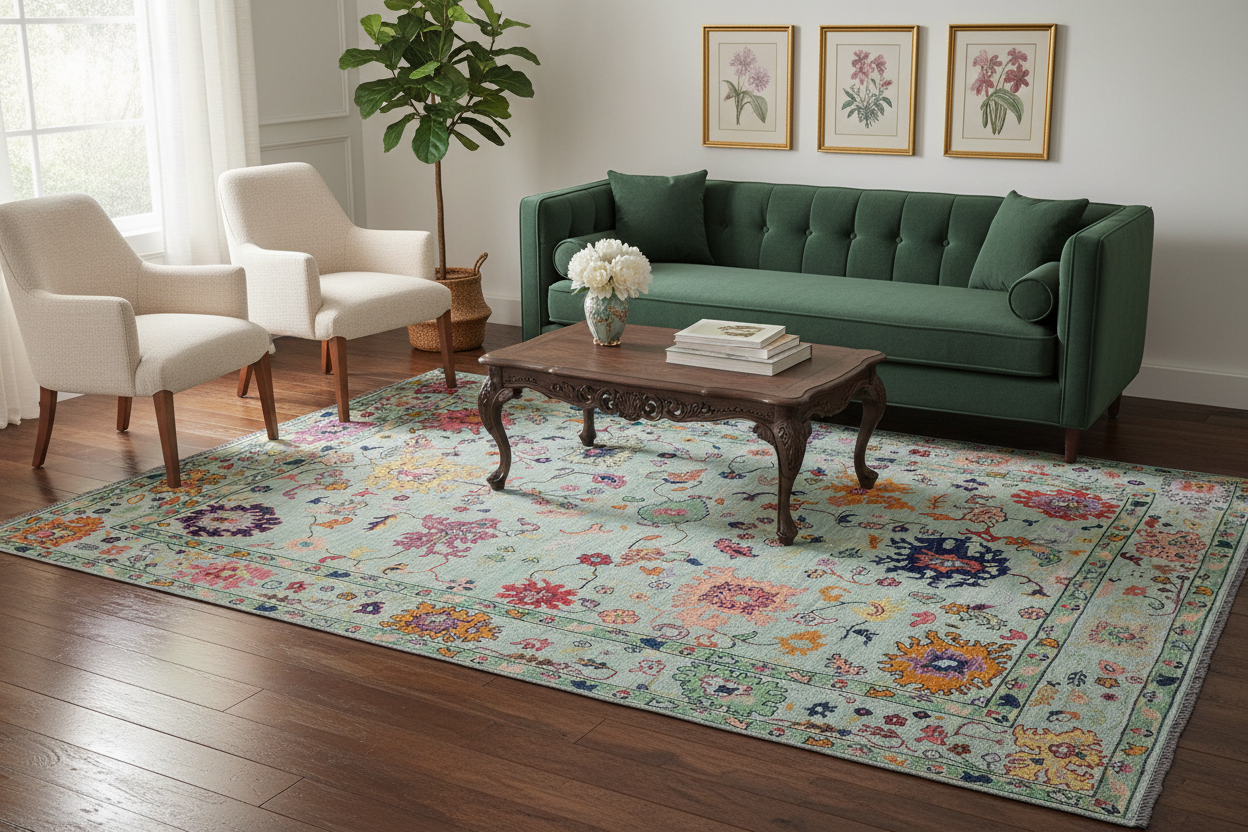
Persian Nain Rugs: 9/6/4 LAA System & Buying Guide
Persian Regions · Nain
Persian Nain Rugs: The Complete Guide.
Nain is the newest of Persia's great weaving traditions — a 20th-century arrival that quickly became one of the finest. Ivory palettes, silk highlights, and the distinctive "LAA" quality tier system that measures Nain fineness.
[ Hero: Persian Nain rug with ivory field and blue accents, showing silk highlights.
Recommended size: 1600×900px ]
Recommended size: 1600×900px ]
Nain is unusual in the Persian rug world because it's a young tradition. While Kashan and Isfahan trace back to the Safavid era or earlier, Nain's rug-weaving story really begins in the 1920s. In under a century, it went from producing no rugs at all to producing some of the finest hand-knotted work in Persia. Here's the whole story.
01 — OriginThe textile-town-turned-rug-city.
Nain is a small city in central Iran, roughly 100 miles east of Isfahan. Historically, Nain was famous for producing high-quality wool textiles — particularly the fine wool robes worn by clerics and wealthy Persians. In the early 20th century, when demand for these traditional textiles declined, Nain's skilled wool workers pivoted to rug weaving.
The pivot took roughly 20 years to mature. By the 1940s, Nain workshops were producing hand-knotted rugs that rivaled the finest work from Isfahan and Kashan. Because the textile tradition supplied Nain with exceptional wool spinners and dyers, and because the transition was recent enough to avoid regional design conservatism, Nain workshops rapidly innovated.
02 — DesignThe Nain signature.
Nain design is curvilinear floral, similar to Isfahan but with distinctive characteristics:
- Central medallion on ivory or cream field, similar to Isfahan.
- Elaborate corner spandrels echoing the medallion.
- Field filled with palmettes, arabesques, and vines — but less densely than Isfahan. Nain fields typically have more visible ground color.
- Silk-highlighted design elements — the flower centers, medallion outlines, and calligraphic borders are often picked out in silk within a wool ground.
- Multiple borders — usually 5-7 with intricate drawing.
The Nain look is often described as "quieter than Isfahan" — less pattern density, more restrained palette, more visible ivory ground. This gives Nain rugs a slightly more contemporary feel that suits modern Western interiors particularly well.
03 — The LAA SystemNain's quality measurement.
Nain uses a unique quality measurement called LAA (sometimes spelled "Layeh"), which measures the fineness of the warp threads rather than counting knots directly. LAA counts how many strands of thread make up each warp:
- 9 LAA: 9-strand warp. Standard Nain. Approximately 300 KPSI.
- 6 LAA: 6-strand warp (thinner). Fine Nain. Approximately 500 KPSI.
- 4 LAA: 4-strand warp (very thin). Very fine Nain. Approximately 700-800 KPSI.
Lower LAA number = thinner warps = more knots possible = higher quality tier. When a dealer describes a Nain as "6 LAA" or "4 LAA," they're telling you which quality tier the rug belongs to. See our KPSI guide for how these numbers convert.
04 — Materials & ConstructionFine wool with silk highlights.
Nain uses very fine wool pile with silk highlights, on cotton foundation. The wool is Nain's historic strength — extremely fine, long-staple, dye-receptive. Silk is used within the wool pile to pick out specific design elements: medallion outlines, flower centers, calligraphic cartouches. Full silk-on-silk Nain exists at the very top of the market but is rare.
Nain uses the Persian (asymmetric) knot. The combination of very fine warps (indicated by LAA count) and fine wool produces some of the highest KPSI hand-knotted rugs in Persian production — matched only by Isfahan, Qum silk, and Turkish Hereke.
05 — PaletteIvory, indigo, and silver-blue.
The classical Nain palette is ivory or cream field with deep indigo blue medallion and accents. This ivory-and-blue combination is the most distinctive Nain signature — more distinctive than any other Persian region's typical palette. Some Nain pieces use pale blue or silver-blue grounds instead of ivory, giving them a cool, contemporary feel.
Nain palettes are typically more restrained than Kashan or Kerman — using fewer colors, softer tones, and more visible ground. The result is a rug that reads as elegant rather than exuberant. This has made Nain particularly popular for formal but modern interiors.
06 — Market TiersNain by LAA count.
Standard Nain
9 LAA
~300 KPSI. Solid production quality. Good value for a fine ivory-palette Persian.
Fine Nain
6 LAA
~500 KPSI. Master workshop tier. Silk highlights prominent.
Very Fine Nain
4 LAA
~700-800 KPSI. Top of Nain production. Extraordinary detail, often signed.
07 — PricingNain rewards buying up.
- 9 LAA Nain 8×10: $4,000-12,000
- 6 LAA Nain 8×10: $10,000-25,000
- 4 LAA Nain 8×10: $20,000-60,000+
- Silk-highlighted Nain 6×9: $8,000-30,000 depending on LAA
- Signed Habibian Nain: $30,000-150,000+
The jump from 9 LAA to 6 LAA is dramatic — both in price and in visible quality. If budget allows, 6 LAA delivers significantly more sophisticated drawing and silk detail. 4 LAA is master territory but requires a serious commitment.
Habibian is the most famous Nain workshop — multiple generations of the Habibian family have produced signed master-tier pieces since the 1930s. A signed Habibian carries a significant premium and is easily authenticated.
08 — Identifying AuthenticSigns of a real Nain.
- Ivory or cream field. Nain's most distinctive palette signature.
- Deep indigo medallion and accents. The classic blue-and-ivory combination.
- Silk highlights. Look for design elements that catch light differently — those are silk within the wool pile.
- Curvilinear precision. Fine drawing throughout, but with more visible ground than Isfahan.
- Very fine cotton warps. Check the fringe — Nain warps should be extremely thin and precise.
- High knot density. Even standard Nain exceeds 300 KPSI.
- Signature cartouches. Modern master Nain pieces are often signed.
09 — CareFine Nain deserves care.
Ivory-ground Nains are more soil-sensitive than red or blue Persian palettes. Weekly vacuuming is important. Consider more frequent professional cleaning (every 2-3 years) for high-traffic pieces. Silk-highlighted areas need special care — use only cleaners experienced with wool-and-silk construction. Standard rotation, rug pad, and immediate spill response applies.
— Taimur
Shopping for a Nain?
Browse our Nain collection.
Arsh's inventory includes Nain pieces across the LAA range — from standard 9 LAA production through fine 6 LAA workshop pieces. Every Nain we sell has verified LAA count and knot density disclosed. Tell us your target size and quality tier; we'll pull matching options.
- Choosing a selection results in a full page refresh.